St. George Homes for Sale
with RV Garages
Homes with dedicated RV storage — deep bays, tall doors, and pull-through access across St. George, Hurricane, and Sand Hollow. Built for the big rig and everything that goes with it.
Browse RV Garage HomesAll Rigs Covered
Pull-Through Available
Washington & Hurricane
Up to $12M+
227 Properties Available
- 1/45 45
 New
New$ 1,239,000
5 Beds4 Baths3,478 SqFt3159 S 530 E, Washington, UT 84780
Single Family Home
Listed by LUME REAL ESTATE

- 1/53 53
 New
New$ 859,000
4 Beds2.5 Baths2,322 SqFt355 W Foster LN, Ivins, UT 84738
Single Family Home
Listed by EXP REALTY LLC (So Utah)
- 1/51 51
 New
New$ 1,299,000
4 Beds3.5 Baths3,007 SqFt174 N 225 W, Virgin, UT 84779
Single Family Home
Listed by HOLIDAY RESORT REALTY
- 1/63 63
 New
New$ 1,200,000
5 Beds4 Baths2,801 SqFt3240 S Noble DR, Washington, UT 84780
Single Family Home
Listed by FATHOM REALTY SG
- 1/29 29
 New
New$ 599,000
4 Beds2 Baths1,884 SqFt1268 E Cheyenne WAY, Washington, UT 84780
Single Family Home
Listed by Real Broker, LLC
- 1/70 70
 New
New$ 2,300,000
5 Beds4.5 Baths4,809 SqFt1696 E Howard LN, St George, UT 84790
Single Family Home
Listed by S. HINDI REAL ESTATE INC
- 1/115 115
 New
New$ 3,350,000
6 Beds6 Baths8,298 SqFt1476 W Top Rope CIR, St George, UT 84770
Single Family Home
Listed by Real Broker, LLC
- 1/63 63
 New
New$ 849,900
4 Beds3.5 Baths3,529 SqFt148 Shadow Point DR, St George, UT 84770
Single Family Home
Listed by RED ROCK REAL ESTATE
- 3D
 New
New$ 1,099,900
6 Beds4 Baths3,550 SqFt2628 E Moorland DR, St George, UT 84790
Single Family Home
Listed by ERA BROKERS CONSOLIDATED SG
- 1/74 74
 New
New$ 4,250,000
6 Beds7 Baths6,632 SqFt3341 E 2250 ST S, St George, UT 84790
Single Family Home
Listed by KW Ascend Keller Williams Realty
- 1/38 38
 New
New$ 864,990
6 Beds5 Baths3,263 SqFt6264 E Endora ST Lot 407, St George, UT 84790
Single Family Home
Listed by Canyon Mill Realty, LLC
- 1/10 10
 New
New$ 569,900
4 Beds2 Baths2,280 SqFt723 E 350 S, Enterprise, UT 84725
Single Family Home
Listed by CENTURY 21 EVEREST ST GEORGE
- 1/66 66
 New
New$ 1,345,000
5 Beds4.5 Baths3,525 SqFt994 W 1920 S, Hurricane, UT 84737
Single Family Home
Listed by KW Ascend Keller Williams Realty
- 1/115 115
 Active
$ 2,600,000
6 Beds6 Baths5,000 SqFt2829 S 3200 W, Hurricane, UT 84737
Single Family Home
Listed by RED ROCK REAL ESTATE
- 3D
 Active
$ 1,249,900
6 Beds6.5 Baths4,922 SqFt165 N Main ST, Leeds, UT 84746
Single Family Home
Listed by EXP REALTY LLC (So Utah)
- 1/36 36
 Active
$ 799,990
4 Beds3.5 Baths2,309 SqFt2551 S 3600 W, Hurricane, UT 84737
Single Family Home
Listed by EQUITY REAL ESTATE PROSPER GRP
- 1/58 58
 Active
$ 1,649,000
6 Beds5.5 Baths4,963 SqFt3229 S 465 E, Washington, UT 84780
Single Family Home
Listed by RED ROCK REAL ESTATE
- 1/34 34
 Pending - Accepting Backup Offers
$ 1,049,000
7 Beds4.5 Baths5,634 SqFt872 W Morby ST, Washington, UT 84780
Single Family Home
Listed by THE AGENCY ST GEORGE
- 1/61 61
 Active
$ 1,350,000
6 Beds6 Baths4,041 SqFt4943 S Ripple RD, Washington, UT 84780
Single Family Home
Listed by FATHOM REALTY SG
- 1/22 22
 Active
$ 7,250,000
4 Beds6 Baths6,786 SqFt2031 E Pinnacle DR, St George, UT 84790
Single Family Home
Listed by KW Ascend Keller Williams Realty
- 1/57 57
 Active
$ 3,500,000
6 Beds7 Baths8,986 SqFt2412 S Breckenridge DR, St George, UT 84790
Single Family Home
Listed by ERA BROKERS CONSOLIDATED SG
- 1/40 40
 Active
$ 1,095,000
4 Beds3.5 Baths2,650 SqFt673 W 280 S, Ivins, UT 84738
Single Family Home
Listed by RE/MAX ASSOCIATES ST GEORGE
- 1/42 42
 Active
$ 725,000
3 Beds2 Baths1,974 SqFt1720 Lava Cove DR, Santa Clara, UT 84765
Single Family Home
Listed by RE/MAX ASSOCIATES FARMINGTON
- 1/66 66
 Active
$ 4,299,900
7 Beds7.5 Baths14,526 SqFt2512 W Malaga Ave, Santa Clara, UT 84765
Single Family Home
Listed by RED ROCK REAL ESTATE
Homes for Sale with RV Garage Under $700,000 | St. George, Hurricane & Washington
Hurricane · St. George · Washington
St. George, Hurricane, and Washington each have solid selection at this price point across Southern Utah. St. George and La Verkin have bays up to 50 ft available here. Not all communities are HOA-free — confirm before you buy.



Homes for Sale with RV Garage Up to $1 Million | St. George, Ivins & Santa Clara
Hurricane · Washington · St. George · Ivins
Hurricane has the deepest selection of RV garage homes in the St. George area at this price point. Bays over 50 ft and 14' tall doors are common throughout Hurricane. Ivins enters the market at the top of this tier with a smaller selection on larger lots.
Adventure Ready RV Homes
St. George RV Garage Homes Under $1M — Washington, Hurricane & Sand Hollow
Room for the rig, the truck, and everything that goes with them. Under $1M across Washington, St. George, and Hurricane you'll find homes with Class A height, deep bays, and dedicated RV storage — in communities like Finley Farms, Sand Hollow Village, Crimson Vistas, and Dixie Springs. New construction and established homes, built around the garage from the start.
What Does Your Rig Actually Need?
Not all RV garage homes fit all rigs. The specs that matter — door height, bay depth, and interior width — vary significantly by rig class. Use this as a starting point, then verify the actual measurements at the showing.
- Rig Length 17–24 ft
- Door Height Needed 9–10 ft
- Bay Depth Needed 22–28 ft
- Bay Width Needed 10–12 ft
Fits in most oversized standard garages. True RV garage not required.
- Rig Length 22–32 ft
- Door Height Needed 11–12 ft
- Bay Depth Needed 28–38 ft
- Bay Width Needed 12–14 ft
Verify door height carefully — many "RV garages" are built for Class A and exceed what Class C needs.
- Rig Length 30–45 ft
- Door Height Needed 13 ft minimum
- Bay Depth Needed 36–46 ft
- Bay Width Needed 14–16 ft
Most St. George RV garage homes are built to this spec. Confirm interior ceiling height — not just door height.
- Rig Length 40–45 ft
- Door Height Needed 14 ft
- Bay Depth Needed 45–60 ft
Fewer listings meet this spec. Jay pre-screens bay depth and approach grade before scheduling a showing.
Homes for Sale with Large RV Garages Over $1 Million | Ivins, Santa Clara & Sand Hollow
Washington · Hurricane · St. George · Ivins
Over $1M, RV storage shifts from an add-on to a planned feature. Hurricane and the broader St. George area lead Southern Utah at this tier, with bays over 50 ft, 14' tall doors, and conditioned space throughout. Casitas, dual-A/C garages, and RV dump stations appear regularly. Ivins offers a smaller selection on larger acreage lots.
Custom Homes with RV Garages Up to $3 Million | Ivins & Santa Clara, Utah
Washington · Hurricane · St. George · Ivins
Hurricane and the St. George area lead this tier across Southern Utah. Bays over 50 ft with conditioned space, dual A/C, RV dump stations, and 14'×14' doors are common at this price point. Guest houses and casitas in the same footprint are a defining feature here.
ST. GEORGE · WASHINGTON · HURRICANE
Luxury RV Garage Homes Under $3M — St. George, Washington & Hurricane
Homes across Washington, St. George, and Hurricane with Class A height, deep bays, and dedicated RV storage — new builds and established properties alike. Built for the lifestyle, not adapted to it. Whether you're storing a Class A motorhome, a toy hauler, or a full off-road fleet, these homes are engineered around the equipment — with extra-height doors, extended-depth bays, and garages that treat your rig as seriously as the house itself. Minutes from Sand Hollow Reservoir, Zion, and hundreds of miles of Southern Utah trail access. This is the market where the garage is part of the floor plan from day one.

Estate Homes with RV Garages Over $3 Million | Ivins & Santa Clara, Utah
St. George · Washington
St. George and greater Washington County hold the top tier of Southern Utah's RV garage market. Coach garages over 55 ft with 14'×14' doors, multi-bay configurations, and dedicated boat storage alongside the coach bay. Purpose-built estates where the storage plan drove the architecture.
ULTRA-LUXURY RV ESTATES
St. George RV Garage Estates $3M and Above — Stone Cliff & Beyond
At this level, the garage is an estate feature — 13-car capacity, 50-foot climate-controlled bays, custom builds on private lots with red rock views. Stone Cliff leads the ultra-luxury tier in St. George, with properties that treat the rig, the collection, and the lifestyle as equals. These are trophy homes built for buyers who don't compromise on any of it.


The Garage Gets Verified Before the Showing Gets Scheduled
Jay takes the time to understand what you need — including the garage. Through a custom search, he can filter for extra door height, extra bay width, and extended bay depth that standard MLS searches miss. If the specs matter to your rig, they matter to the search.
His experience building and storing vehicles gives him a practical eye for what actually works. He'll help you evaluate whether a garage fits your collection, your workflow, and the way you use it — not just whether it has the right checkbox. Call, text, or email: (435) 466-3784 · jay@yourstgeorgelife.com · Red Rock Real Estate
Homes for Sale with RV Parking in Washington County, Utah
RV Pad · No HOA · Side-Load · All Areas
Not every buyer needs an enclosed garage. If you're storing a Class B, trailer, or boat, a dedicated RV pad with hookups covers the requirement — and opens up a much larger selection of homes across Southern Utah. These listings are filtered for confirmed RV parking with no HOA restrictions on outdoor vehicle storage.
NOT EVERY RIG NEEDS A GARAGE
Southern Utah Homes with Dedicated RV Parking — Wide Lots, HOA-Flexible
Not every buyer needs a 14-foot door. If you're storing a trailer, boat, or rig, a wide side-pad and the right HOA rules get you there for less. These homes across St. George, Washington, and Hurricane offer dedicated RV parking, wide lot lines, and associations that won't fight you over what's in your driveway.


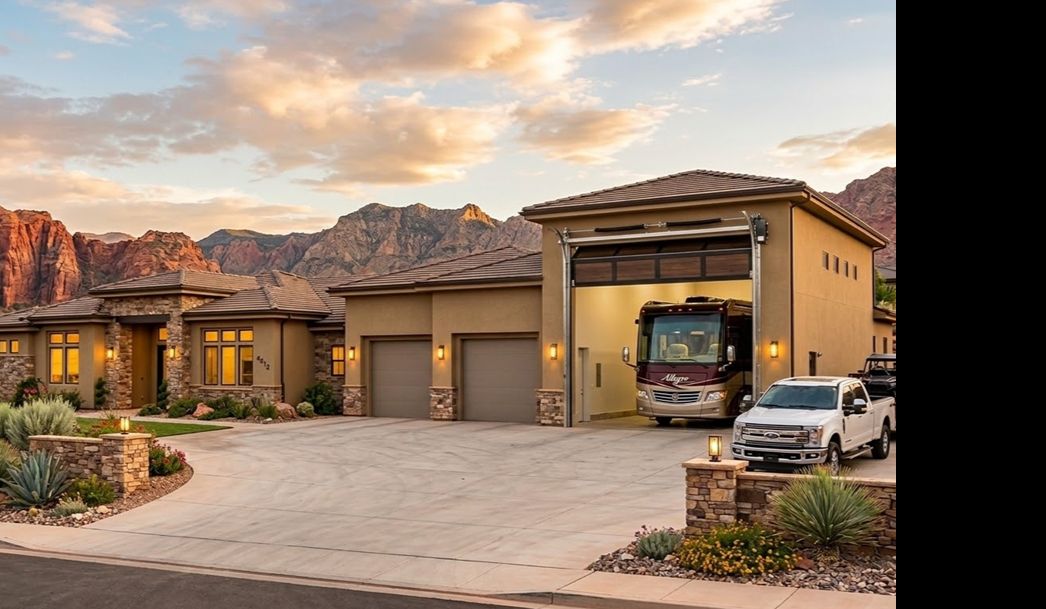
St. George Homes with RV Garages Built for the Lifestyle
When your Class A motorhome or toy hauler lives at home, the trip starts when you're ready — not after a storage facility run. St. George homes with RV garages in Washington, Hurricane, Ivins, and Santa Clara put your rig in the garage and the trailhead at your doorstep.
Sand Hollow Reservoir, Zion National Park, Bryce Canyon, and Lake Powell are all within a day's drive, with over 300 days of sunshine to make every one count. Extra-height doors, deep bays, and dedicated RV parking — because your motorhome deserves the same address you do.
— Jay Payson · Red Rock Real Estate · (435) 466-3784
How St. George RV Garage Homes Differ from Standard 2–3 Car Garages
RV garage homes in St. George, Washington, and Hurricane are built for extra height, depth, and sometimes width — 12–16-foot doors, 40–60-foot bays, and hookups for motorhomes or toy haulers. Many include a 3–4 car garage plus a separate RV bay so daily drivers and weekend rigs stay under one roof.
They also solve the HOA problem: where exterior RV parking is restricted or prohibited, an enclosed bay keeps your rig compliant and protected year-round. Most buyers don't realize how many communities in Washington County ban long-term exterior RV storage until they're already under contract — Realtor Jay Payson reviews HOA rules and CC&Rs before a showing so there are no surprises after you're emotionally invested.
Need extra bays for a boat or UTV without the RV-height premium? Browse large garage homes →
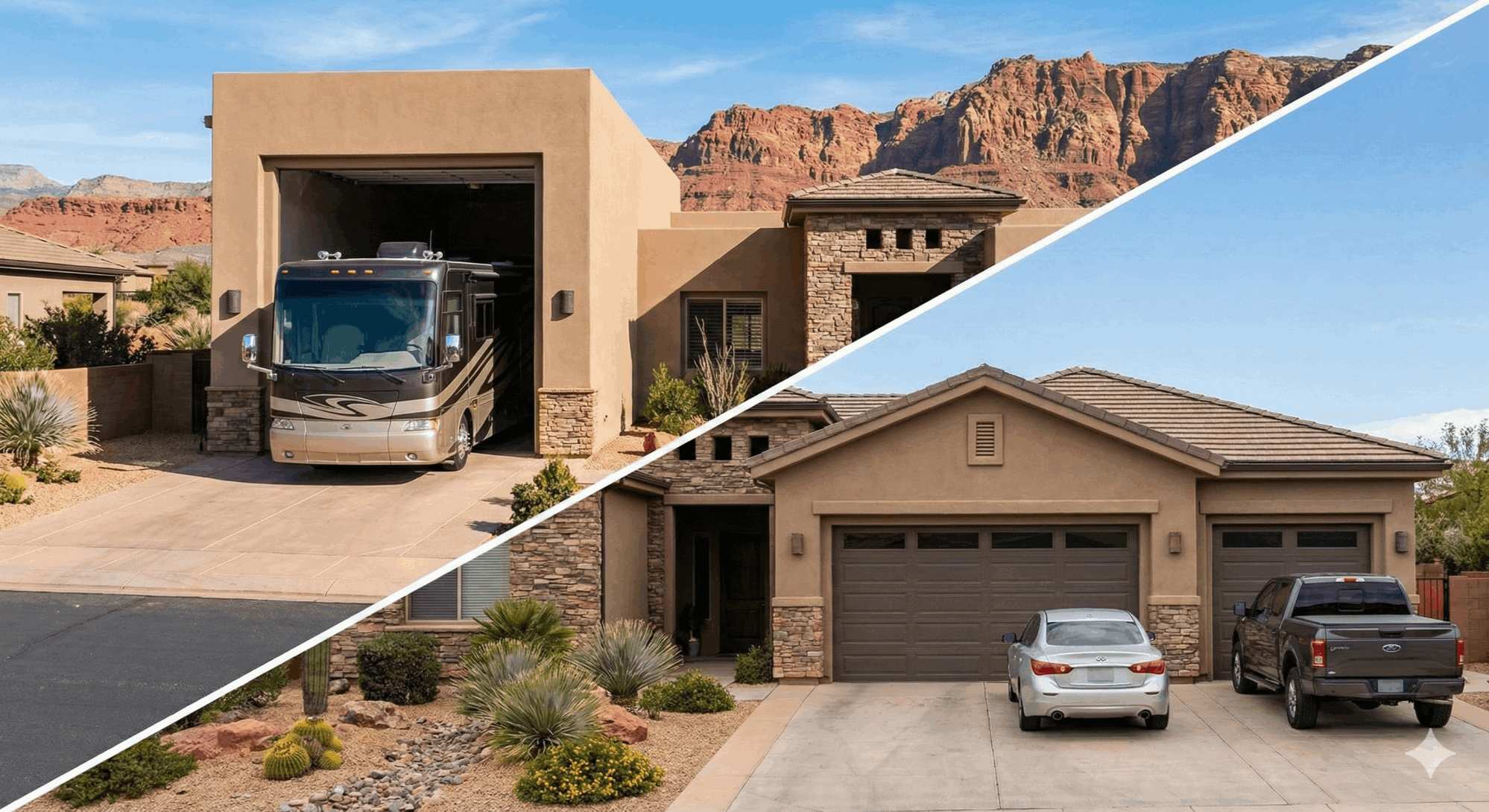
What to Look for When Touring an RV Garage Home
An RV garage home that looks right in photos can still be wrong for your rig. Door height, bay depth, approach angle, and hookup access all have to line up — and most listings don't disclose the details that matter. Here's what Realtor Jay Payson checks, and what you should be looking at, before you fall in love with a floor plan.
Door Height
Interior Ceiling Height
Bay Depth
Bay Width & Slide-Out Clearance
Approach Angle & Curb Height
Electrical Hookups
Water Access
Sewer & Dump Access
Ventilation
Insulation
Daily Driver Storage
HOA & CC&Rs
Realtor Jay Payson verifies these specs against your rig before recommending a showing. Tell him your rig length, door height requirement, and hookup needs — he'll bring you properties that clear your requirements, not just listings tagged as RV garages.
New to buying in Utah? Read Before the Showing →
RV Garage FAQ — St. George, Washington & Hurricane
Have questions about buying an RV garage home in St. George, Washington, or Hurricane? This FAQ covers what to look for in a true RV garage, how MLS searches miss the details that matter, and how Jay Payson makes sure the home fits your rig before you ever make an offer.
What makes a home a true RV garage home — and why can't I just search MLS?
What are typical RV garage sizes and layouts in St. George?
What ceiling height do I need for a Class A motorhome?
How do we narrow down the search to homes that actually fit my motorhome?
How much can an HOA restrict RV garage use or exterior parking?
Which communities in Greater St. George consistently have RV garage homes?
Is this mostly new construction, or are there resale options?
What price range should I expect for a home with a true RV garage in St. George?
How do you differ from searching on Zillow, Redfin, or Realtor.com?
St. George Homes with Oversized Garages
for Boats, UTVs & Workshop Space.
For the buyer who needs the space but not the extra door height — boats, UTVs, side-by-sides, and workshop setups fit comfortably in a standard oversized or multi-bay garage. These homes across Hurricane and Washington City give you the storage and the lifestyle without the RV garage price premium.
Browse Large GaragesRealtor Jay · Red Rock Real Estate
Start With a Conversation
Jay works with a limited number of buyers and sellers at any given time. A short consultation is how we find out if we're the right fit — your goals, your timeline, what you're actually looking for. Straightforward follow-up, no spam. If it's a match, we get to work.
(435) 466-3784 jay@yourstgeorgelife.com